
Shopify is calling this the first holiday season of the agentic era. According to its 2026 Global Holiday Retail Report, 65% of shoppers plan to use AI for at least one shopping task this season. The shift could be particularly interesting for smaller brands. Shopify found that 71% of regular AI users are more likely to choose an independent brand this year than last.
AI can sift through enormous amounts of product information in seconds, comparing options across brands a shopper might never have heard of. Someone looking for a specific combination of features, price, and quality no longer needs to know which brands to search for first. For smaller merchants, that creates an opportunity to compete on how well their products meet a customer's needs rather than relying entirely on brand recognition or advertising budgets.
AI recommendations aren't entirely neutral, and visibility still depends on which products and information a particular system can access. But with Google expanding shopping capabilities in AI Mode and Gemini, and Shopify developing AI shopping channels, the way customers discover and purchase products is changing.
The New Rules of Getting Discovered
Imagine a shopper asking an AI assistant:
"Find me a waterproof carry-on backpack under $150 that fits a 16-inch laptop, has good reviews, and can arrive before Friday."
Instead of browsing through pages of search results, the shopper could receive a shortlist of products matching those requirements, including brands they've never encountered.
Traditional SEO helps search engines find, understand, and rank your website. AI shopping adds another consideration: whether a system can retrieve and interpret enough reliable product information to recommend you for a specific request.
A beautifully designed product page won't necessarily help if the specifications are buried in images, the available sizes are unclear, or the price in your product feed doesn't match your website. Product information needs to be accessible, accurate, and painfully clear.
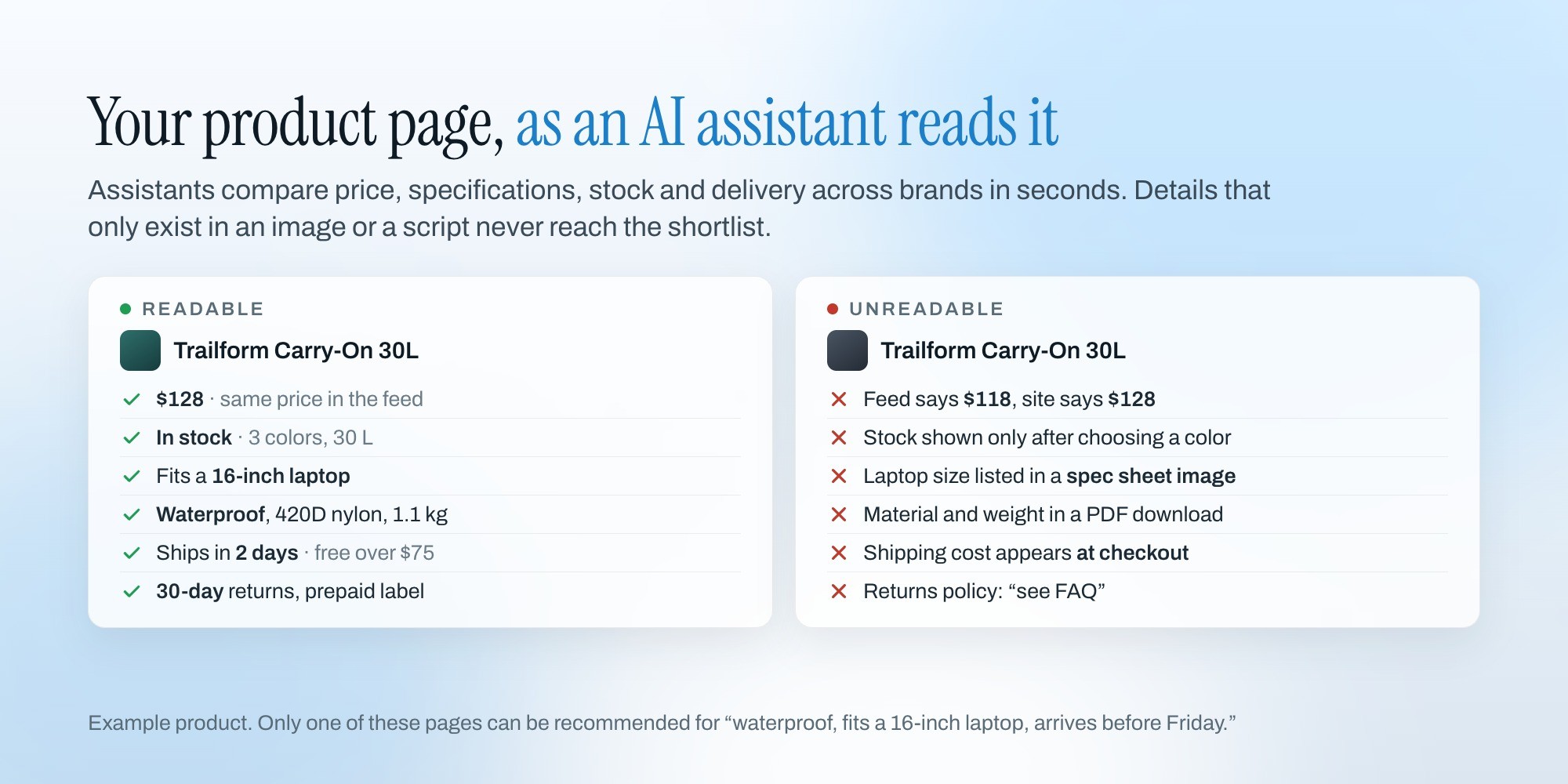
Example product. The checklist below covers each of these details.
Your AI-readiness checklist
Done | Check |
|---|---|
☐ | Keep product feeds accurate. Prices, inventory, availability, and promotions should match your website. Review Google Merchant Center and other shopping feeds you maintain. |
☐ | Use structured product data. Implement Product structured data to help supported systems interpret product details, prices, availability, and variants. |
☐ | Answer the questions shoppers actually ask. Include materials, dimensions, compatibility, intended use, and other specifications that help distinguish your products. |
☐ | Make variants unmistakable. Clearly identify sizes, colors, configurations, prices, and stock levels. |
☐ | Make delivery and return information easy to find. Shipping costs, delivery estimates, and return conditions can determine whether a product meets a shopper's requirements. |
☐ | Check accessibility. Make sure relevant product pages can be crawled and that important details aren't available only through images or scripts. |
☐ | Test realistic AI shopping queries. Ask supported AI tools questions your customers might ask. See whether your products appear and whether the information is correct. |
When AI Stops Advising and Starts Buying
There's a big difference between asking AI which laptop to buy and asking it to buy one for you. In most AI-assisted shopping experiences, the customer still completes the purchase, often through the merchant's regular checkout.
Agentic commerce goes further. With a customer's authorization, an AI agent can take action on their behalf. Depending on the platform and payment integration, that might include selecting a product, initiating checkout, or completing a transaction.
Secure agentic payments require more than identifying the agent. The system also needs a way to establish the customer's authorization, authenticate the transaction where required, and handle payment credentials appropriately.
Mastercard Agent Pay, for example, focuses on enabling secure, consumer-authorized payments involving AI agents. These experiences can use payment credentials designed for agentic transactions rather than requiring an agent to possess a shopper's raw card details.
Check with your eCommerce platform and payment provider about support for agent-initiated transactions, customer authorization, authentication, and any required integrations. Where supported, test the complete process from customer approval through payment confirmation.
Some AI shopping tools will continue sending customers to a merchant's website to complete their purchase. Others may support more integrated transactions. The checkout requirements depend on which experience is being offered, so merchants shouldn't assume that appearing in an AI shopping channel means their store supports agent-executed payments.
Are Your Bot Protections Turning Away Real Customers?
It's likely that your store's bot protection can't always tell the difference between an AI agent shopping on behalf of a legitimate customer and a bot trying to exploit your website.
Tools such as Cloudflare Bot Management, Akamai Bot Manager, and CAPTCHA systems detect and restrict automated activity using signals such as IP reputation, browser characteristics, and request patterns. A legitimate shopping agent might operate from cloud infrastructure, navigate product pages unusually quickly, or interact with checkout differently from a human shopper. Depending on your security settings, that behavior could trigger a challenge or block the agent before it reaches payment.
Visa's Trusted Agent Protocol is designed to help merchants and technology providers verify legitimate shopping agents using identity information that compatible systems can validate. Instead of relying solely on behavioral signals, participating systems can use verifiable identity information to help distinguish recognized agents from unidentified automation.

Example values. A Visa-approved agent signs each request, and your bot protection validates the signature against Visa's public keys before it decides what to do with the visit.
Verifying an agent's identity is not the same as authorizing a payment. A recognized agent still needs to operate within the customer's authorization, and the transaction must satisfy applicable payment authentication and security requirements.
Ask your eCommerce platform or bot-management provider whether it supports verified shopping agents, including Visa's protocol, and how those requests are handled. If reporting is available, review blocked or challenged automated traffic for potential false positives. Where trusted-agent verification is supported, work with your provider to accommodate verified agents without weakening protections against malicious bots.
The Opportunity Is Bigger Than the Technology
AI shopping could help smaller brands reach customers who might otherwise gravitate toward familiar names. That opportunity will depend partly on whether AI tools can understand their products and whether the available purchasing experiences work with their storefronts.
Much of the preparation builds on familiar eCommerce fundamentals. Clear product information helps customers and shopping tools make informed decisions. Reliable checkout and appropriate security controls help legitimate purchases go through.
At Compaytence, we help merchants navigate the payment side of that shift, from checkout performance to secure payment acceptance.
The Compaytence Brief covers the infrastructure, economics and strategy behind payments and banking.