
Take last month's total fees and divide them by last month's volume. That percentage is your effective rate, and it is always higher than the rate you were quoted.
The difference is everything the quoted rate leaves out. That rate covers the transaction. The bill covers the transaction, the network, the processor, the gateway, the compliance program, the batch, the statement, and every dispute that landed.
For online merchants, the 2026 interchange-plus weighted average sits around 2.31% plus 25 cents per transaction. If your effective rate is well above that, the gap is not interchange. Interchange is roughly the same for everyone in your category.
The gap is in the other lines, and there are usually more of them than you would expect. A statement can run to fifteen or twenty entries, several of them named to sound like a charge a bank or a regulator handed down. Nobody handed down most of them.
What you are actually paying for
Three parties handle a card payment before the money reaches your account, and each charges for its part.
The biggest of those charges is interchange, and it is the one most merchants misunderstand. It goes to the issuing bank, which fronts the money at the moment of purchase and absorbs the loss if it goes unpaid. Visa and Mastercard publish the interchange rates, but the cash goes to the bank. These fees are set by card type and business category, and they are among the few charges on your statement that cannot be negotiated.
Visa and Mastercard are paid separately, through assessments, for operating the network the payment travels across and writing the rules everyone follows.
Your processor is paid last. It connects your store to that network, submits each transaction for authorization, handles settlement and deposits the money in your account.
While interchange and assessments are fixed charges, the rest is for the processor.
You cannot negotiate what the banks and the networks charge. You can negotiate everything your processor adds on top.
On an interchange-plus statement, that markup is a visible line you can point at. On tiered or flat-rate pricing it is folded into a blended number with no itemization, which makes it far harder to see what you are actually paying for. That is the entire reason blended pricing exists, because you cannot argue with a figure you cannot understand.
All the add-ons
Splitting the markup across several official-sounding lines is standard practice, and the names are chosen to imply a third party. Statement audits published by Merchant Cost Consulting document the recurring ones: Regulatory Product Fee, Network Access Fee, Industry Compliance Fee, Risk Assessment Fee, Enhanced Security Fee, Settlement Funding Fee, Infrastructure Upgrade Fee. All of these are just extra cash for your processor.
The fees are significant. Risk assessment fees have been found running anywhere from 0.05% to 3% of total volume. One processor bills a "card network support fee" at roughly 0.25% of American Express volume. Amex never charges it, and the processor keeps every cent. Another bills an "international card handling fee" of 0.60% and lists it right next to the real Mastercard cross-border fee, so it reads as part of that charge.

The subtler version is padding the lines that are genuinely fixed. Visa assessments are 0.13% on debit and 0.14% on credit. Audits have found them billed at over 0.30%. Discover's 0.13% has been billed at 0.28%, Mastercard's 0.1275% and 0.1475% at 0.274% and 0.32%. The difference stays with the processor, and it is close to invisible, because it is sitting on the one line you were right to assume you could not negotiate.
How to tell a real fee from an invented one
Ask whether the money leaves the building. A real pass-through goes to a card network or a bank, and costs every merchant the same. Anything that stays with your processor, and changes from one merchant to the next, is markup under another name.
One month, line by line
A mid-risk eCommerce account, $250,000 processed across 2,500 transactions, roughly 18% of volume on foreign-issued cards.
Line item | Charge | Who sets it | Negotiable |
|---|---|---|---|
Interchange, 1.95% + $0.10 | 5,125 | Card networks | No |
Assessments, billed at 0.25% | 625 | Networks + processor | In part |
Cross-border assessment on $45,000 | 450 | Card networks | No |
Processor markup, 0.45% + $0.10 | 1,375 | Processor | Yes |
Network access fee, 0.10% | 250 | Processor | Yes |
Gateway authorization, $0.05 per txn | 125 | Processor | Yes |
Gateway monthly | 25 | Processor | Yes |
PCI program fee | 39 | Processor | Yes |
Statement fee | 15 | Processor | Yes |
Batch fees, 30 days | 8 | Processor | Yes |
Chargeback fees, 12 at $25 | 300 | Processor | Partly |
Total charged: $8,337 on $250,000, an effective rate of 3.33%. Two lines there are worth a second look. The assessments are billed at 0.25% against a true cost near 0.14%, so $275 of that $625 is the processor's markup billed under the network's name. The network access fee is $250 for nothing at all.
Of the total, 2,412 dollars was set by the processor rather than the networks. That is 29% of the bill, and only $1,375 of it was labeled as the processor's own charge.
Move the markup to a competitive eCommerce benchmark of interchange plus 0.20% plus 8 cents, bill the assessments at cost, drop the invented line, and take the gateway monthly, PCI, statement and batch fees to zero, which processors routinely waive to keep an account. The effective rate falls to 2.82%. That is $1,287 a month, 15,444 dollars a year, on identical volume. No new customers, no new products, no ad spend.
On the numbers
Illustrative statement, not a client account. Rates are drawn from published 2026 interchange-plus averages and card network fee schedules. Your own figures will differ by category, card mix and region.
What actually moves the price
Your leverage comes from two places: how risky your account looks, and how easily you could take it elsewhere.
Volume you will commit, not just volume you have. A processor prices for the account you will be next year, so offer them that account directly: a monthly floor routed through them in exchange for a lower rate, or a tier that steps down as you cross agreed thresholds. Asking for a discount is a request. Committing volume for it is a deal, and processors are inclined to say yes to deals.
A dispute ratio with room under the threshold. The strongest card most merchants hold without playing it. Visa's VAMP threshold sits at 1.5% and Mastercard's programs trigger in the same territory. A merchant running well under those numbers is cheap for an acquirer to hold, and cheap accounts get better terms. Bring the actual ratio to the conversation, not a claim that it is low.
Processing history that survives underwriting. Six clean months with no freezes, no reserve and no monitoring placement converts you from an unknown into a priced risk, and priced risk is negotiable in a way unknown risk is not. Bring the statements rather than describing them. An underwriter who can read three to six months of settled volume, refund rates and dispute history will quote you properly on the first pass, which is usually where the better number comes from.
Transaction data and settlement timing. Every transaction is checked against interchange qualification rules, and one that misses them downgrades to a more expensive category, adding 0.50% to 1.50% to that sale. The causes are avoidable: missing AVS or CVV data, manually keyed orders, and batches settled outside the 24 to 48 hour window. Send full AVS and CVV on every order and settle daily. If you sell to businesses, pass Level 3 invoice-quality data, and note that Visa sunset Level 2 interchange for commercial cards in April 2026, so that route is closed.
A second processor already live. A merchant who can route volume elsewhere tomorrow is negotiating. A merchant on a single account is asking. Your processor wants every transaction you run, and anything clearing somewhere else is money they lose.
The renewal window. Terms move most in the weeks before a contract expires, when an early termination fee is no longer holding you in place. Most agreements roll into another full term automatically unless you give written notice 30 to 90 days ahead, so put that deadline in your calendar. Miss it and the term resets along with the fee. Check which kind you are carrying, too: a flat charge of $100 to $500, or a liquidated damages clause that bills you for the revenue the processor expected over the rest of the term.
Why this conversation never happens on Stripe
Everything above assumes there is someone on the other side of the table. On Stripe, Shopify Payments or PayPal, there isn't.
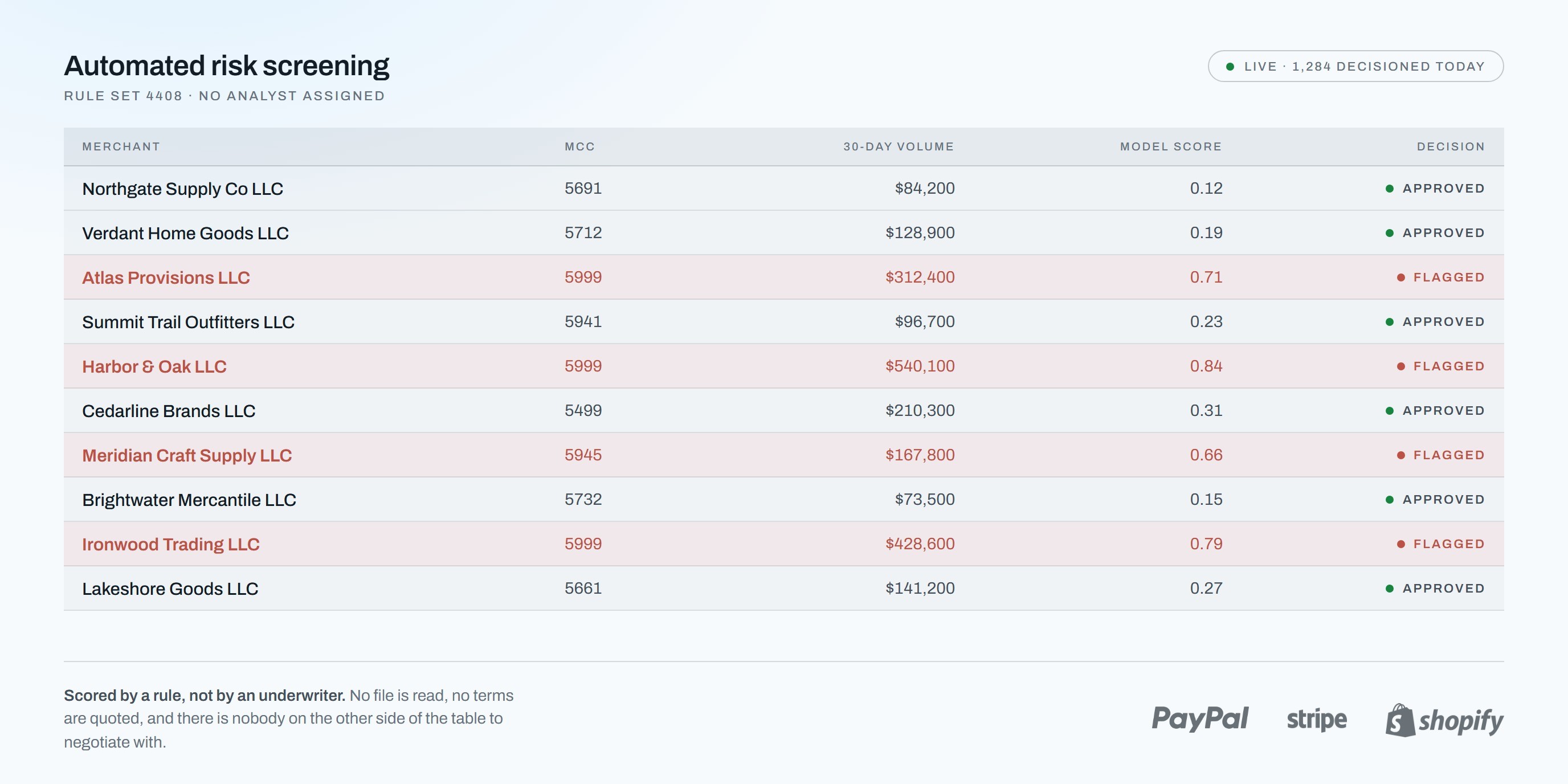
Those are aggregators. They onboard you in an afternoon by placing you under a master merchant account alongside everyone else, and the posted rate is the product. There is no interchange-plus statement to separate, because you were never given one. There is no underwriter assigned to your file, because your file was scored by a rule. There is no contract coming up for renewal, because you clicked through terms instead of signing an agreement. You can move volume, clean up your disputes and triple in size, and the number on the pricing page will be exactly what it was.
Negotiation starts at tier-one acquiring, where a bank underwrites your business specifically and prices your file rather than your category. That is the same structural difference that decides whether a volume spike triggers an automated hold or a phone call. The rate is one consequence of it.
The actual takeaway
Pull last month's statement. Add every charge, divide by the volume you processed, and write down the effective rate. Then mark each line network or processor. Anything you cannot trace to Visa, Mastercard or your acquiring bank is the processor's, and that column is your negotiating position.
If your pricing is blended, start by switching to interchange-plus, so you can see what you are paying for before you try to change it.
How Compaytence fits
A merchant negotiating alone brings one account to the table. We bring a network of 40+ top-tier providers and direct working relationships with the processors, gateways and acquiring banks behind them, which means your rate gets negotiated against a live comparison instead of an incumbent's quote. Favorable provider agreements are part of PSP Setup: lower processing rates, shorter hold-backs, or zero-reserve terms, depending on what your file supports.
Nobody is better positioned to have that conversation on your behalf, because we have it every week, with all of them.
Our payment audit reads your statement the way an underwriter does, line by line, separating the charges that are genuinely fixed from the ones your processor chose.