
PayPal, Shopify & Stripe Holds: Don’t Let Your Processor Keep the Cash
Compaytence Brief · October 5, 2026

You have your best month ever. Sales are flying, ads are working and inventory is moving. Then your payment processor decides to hold, say, 10% of your revenue for the next 90 days.
That’s a reserve. Taking action early can reduce the risk of PayPal, Stripe or Shopify Payments placing a reserve on your account.
Rolling vs. Fixed Reserves: Know What You’re Dealing With
A reserve is money from your sales that your processor sets aside to cover potential refunds, disputes and chargebacks.
A rolling reserve is a common and particularly painful version for growing businesses. The processor holds a percentage of every transaction for a set period. With a 10% reserve held for 90 days, for example, $10 from every $100 you process is held for 90 days and then released on a rolling basis.
The problem is that it grows with you. If you process $100,000, $10,000 goes into reserve. Jump to $300,000 during Black Friday and $30,000 goes in, while you’re still waiting for earlier reserves to be released.
A fixed or minimum reserve keeps a specified amount of money locked. It still restricts your cash, but it doesn’t necessarily increase with every new sale the way a rolling reserve does.
PayPal can also hold individual payments. These payment holds are different from a reserve applied across the account and can have different release conditions.
Whatever the structure, know five things: how much is being held, the reserve type, the hold period, the release schedule and the review date.

What Triggers a Reserve
Think about your account the way a processor’s risk team does. You collect $100,000 from customers, the processor pays you, and you spend the money. If customers later request refunds or file disputes, the processor needs to know those obligations can still be covered.
Risk teams are trying to estimate how much money could potentially come back out of your business after you’ve been paid. Chargebacks and refunds are obvious signals, but sudden changes in sales volume or average order value, longer delivery times, preorders, limited processing history and the risk profile of what you’re selling can also matter.
This is why rapid growth can attract attention. If you’ve historically processed $100,000 a month and suddenly process $400,000, that creates a much larger amount of customer money tied to orders that still need to be fulfilled.
Risk can also compound. A large sales spike with inventory ready to ship and stable dispute rates tells one story. A large spike accompanied by longer shipping times, rising refunds and a surge in preorders tells another.
How to Reduce Your Chances of a Reserve
You can’t guarantee a processor won’t establish a reserve. You can reduce avoidable risk signals and give the processor more context when your business changes.
Tell Them Before You 4X
If you normally process $100,000 per month and expect $400,000 because of Black Friday, consider telling your processor before the volume arrives. Explain why sales are increasing and be ready to provide forecasts, inventory records, supplier invoices and your fulfillment plan.
A planned seasonal spike backed by inventory, delivery capacity and a credible forecast gives the risk team context for the sudden increase in volume.
Don’t Let Sales Outrun Fulfillment
A transaction still carries risk after the customer’s card goes through. You need to deliver the product on the timeline you promised.
Upload tracking promptly, monitor delivery performance and be realistic about shipping promises. If sales are climbing while fulfillment performance is deteriorating, address the operational problem before pushing even more volume through the account.
Preorders deserve special attention because the time between taking the customer’s money and delivering the product can be much longer.
Stop Chargebacks Before They Start
Some disputes are preventable. Use a billing descriptor customers recognize, make customer support easy to reach and respond quickly when someone asks where an order is.
Monitor refund and dispute trends yourself rather than waiting for your processor to flag them. If refunds move from 3% to 4% to 6%, investigate the cause. A particular SKU may be disappointing customers, a supplier may be late or delivery times may have increased.
A deteriorating trend gives you an opportunity to fix the underlying problem early.
Build the File Before You Need It
If your processor reviewed your account tomorrow, could you quickly demonstrate that you can fulfill what you’ve sold?
Keep tracking and delivery data, supplier invoices, inventory records, refund and dispute history, financial information and processing forecasts organized. This gives you a much stronger starting point if the risk team asks about a sales spike or reviews your account.
Could You Absorb a 10% Reserve?
Before peak season, run a simple calculation. If you expect $300,000 in sales and model a 10% rolling reserve, that’s $30,000 potentially entering reserve.
Suppose $10,000 from earlier sales is being released during the same period. Your locked cash has now increased by $20,000.
Could you still buy inventory, fund advertising, pay fulfillment costs and handle returns? Run that calculation before your busiest months so you know how much room you have if a reserve appears.
Already in Reserve? Let’s Talk.
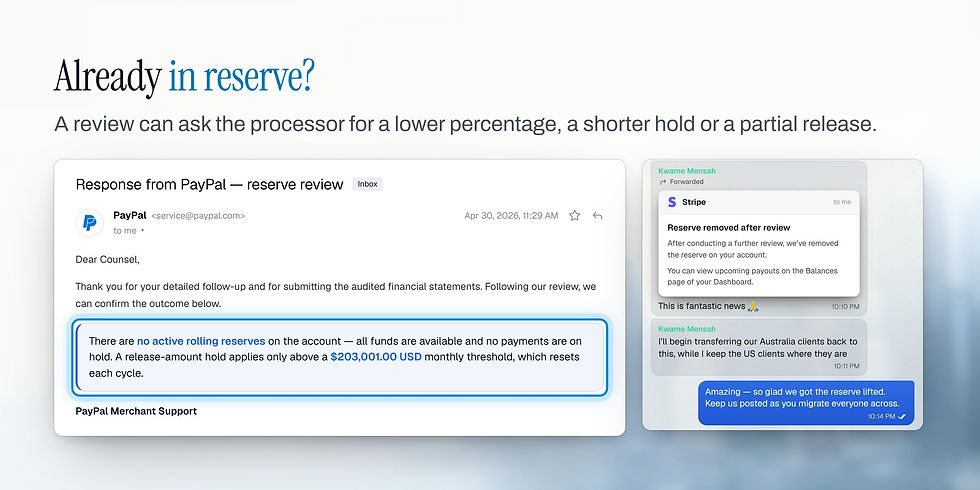
If PayPal, Stripe or Shopify Payments has already placed a reserve on your account, Compaytence Reserve Recovery can help you build the case for a review.
We’ll review the reserve terms and stated reason, identify the evidence that supports your case and determine what can reasonably be taken back to the processor. Depending on the circumstances, that could include requesting a lower percentage, shorter holding period, partial release, different reserve structure or defined review date.
If we believe we can help, we’ll provide a proposal with next steps and timelines at no cost.
The Compaytence Brief covers the infrastructure, economics and strategy behind payments and banking.


Comments