
When Platforms Go AI-First: What Merchants Need to Know

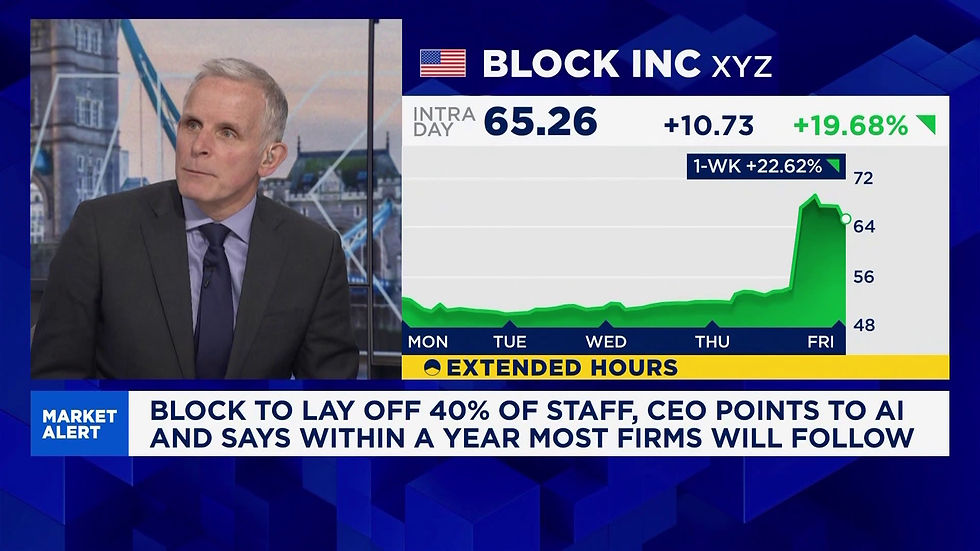
Block’s decision to cut roughly 4,000 roles and lean harder on AI is a preview of the operating model a lot of eCommerce businesses are about to live in: smaller human teams, more software leverage, and a job market that shifts from “more heads” to “more capability per head.”
What Block’s Layoffs Signal
Block is reducing its workforce from a bit over 10,000 people to just over 6,000, with CEO Jack Dorsey explicitly tying the move to “intelligence tools” that change what it takes to build and run a company. Investors rewarded the move immediately, betting that a leaner, AI‑enabled Block will grow profits faster. Salesforce, Amazon, Klarna, Pinterest and others have all announced large cuts while talking up AI. Some of that is classic over‑hiring correction after the pandemic, but the direction is clear: leadership wants fewer people and more automation in the middle and back office.
For merchants using Square, Cash App or Afterpay, that means your payments and commerce platform will be increasingly driven by AI systems for insights, risk, support and personalization, with fewer people behind the scenes. It also signals what your own operating model may need to look like: flatter teams, more decisions driven by real‑time data, and an expectation that software handles most repeatable work.
When Your Processor Becomes an Algorithm
As more of Block’s stack is run by AI, the experience of being a merchant on these platforms starts to feel less like a traditional bank relationship and more like dealing with Facebook or Google Ads: powerful tools, opaque rules, and very few humans you can reach when something goes wrong. Risk and compliance teams already lean on automated systems to flag “suspicious” patterns—chargeback spikes, unusual volumes, odd buying behavior. With smaller teams and more pressure to be efficient, those systems will make more frontline decisions: freezing payouts, throttling volume, or shutting accounts down first and asking questions later.
If you have ever had a social account flagged, the pattern is familiar: you wake up to a warning or shutdown, you are pushed into a self‑service appeal, every day of delay is a day of lost revenue, and there is no obvious human escalation path. As AI runs more of the triage and frontline decision‑making, it becomes harder for platforms to get a nuanced read on your business model, your actual risk, or the context behind a spike in activity. Even well‑intentioned sellers get swept up in automated sweeps, and the burden shifts to you to avoid triggering systems you cannot see.
That makes prevention and redundancy more important than ever. Clean data, transparent operations and proactive documentation become your main defenses, because post‑hoc explanations may never reach a human who can override the system. Once an AI‑driven engine has labeled an account “high risk,” getting that changed without a relationship manager will feel like trying to get a locked ad account reopened. Diversifying processors and adding a backup PSP or secondary rail shifts from “nice‑to‑have” to basic risk management. The upside is that good actors can sometimes be approved and onboarded faster; the downside is that when the system gets you wrong, there may be no one left to listen.

How AI Lets eCommerce Run Leaner
The same forces pushing Block toward AI are available to merchants in a more practical way: tools that let you operate with a smaller team without shrinking your ambition. AI can already reshape merchandising and pricing by analyzing sales, seasonality and competitive data to recommend price changes, bundles and promotions, and in some cases automate those shifts within rules you define. In marketing and creative work, generative tools can draft copy, ads and email flows, segment audiences and optimize campaigns, freeing your team to spend more time on strategy instead of manual production.
Support and operations are shifting as chatbots and agent‑assist systems handle a large share of routine queries, surface order details instantly and draft responses, allowing a smaller support team to cover more hours and channels. In the back office, inventory forecasting, fraud detection, chargeback handling and reconciliation are increasingly model‑driven, which reduces manual spreadsheet work and exception handling. Block is already building some of this into the Square dashboard: AI‑driven recommendations on menus, staffing and customer behavior that sellers can act on “in seconds.” Merchants that lean into embedded tools like these, rather than constantly buying new platforms, can run more experiments, make faster decisions and support more volume with the same—or smaller—teams.
The practical way to start is to audit where your people spend time—support, catalog management, reporting, campaign setup—and target the most repetitive tasks for AI assistance. Use the features already inside your commerce, marketing and payments systems, pilot them on narrow use cases with clear success metrics, and keep humans in the loop to review and approve outputs. Training your existing team to work with AI—prompting, evaluating and understanding limits—will matter more than simply adding new software logos to your stack.
The Job Market: Fewer Seats, Different Skills
A 40% cut at a high‑profile fintech with AI cited as the rationale understandably fuels anxiety, but the job picture is shifting as much as it is shrinking. Big platforms are trimming, while mid‑sized companies in retail, logistics, healthcare and manufacturing are still hiring people who understand data, automation and digital channels. Many of the roles moving out of big players are reappearing in industry‑specific companies that need to run tech‑enabled operations.
Demand is also shifting toward AI‑literate roles. Product managers, marketers, analysts and engineers who know how to design with AI, evaluate tools and keep outputs on‑brand and compliant are becoming more valuable, while purely repetitive knowledge work is more exposed. New work is appearing around the tools themselves: training models on domain data, curating prompts, monitoring quality, managing governance and handling customer‑facing edge cases. For merchants, that means hiring fewer people to do the same manual tasks and more people who can orchestrate and supervise AI‑infused systems—people who understand workflows, data, customer journeys and the tools that sit on top of your platforms.
What This Means for Merchants
For merchants, the question is less “Will AI replace my team?” and more “How do we use the same or smaller team to punch above our weight without losing control?” Block’s move is a signal that your providers will expect you to be comfortable with AI‑heavy tooling, and it is also a reminder that your competitors will be using similar leverage. AI will be baked into your stack as Square, Shopify, marketplaces and marketing tools increasingly ship AI features by default; the merchants who benefit will be the ones that actually turn them on, test them and fold them into daily decisions instead of leaving them idle.
Cost pressure will intensify as platforms operate more cheaply, with some savings going to shareholders and some showing up as lower prices or new bundles. Merchants that use AI to improve their own productivity will have more room to compete on price, service or speed. At the same time, customer expectations will rise as faster responses, better personalization and smarter recommendations become the norm, and any experience that feels generic or slow next to AI‑augmented competitors will stand out in a bad way.
The goal is to use AI to amplify judgment, not remove it. If you assume card networks, processors and commerce platforms will remain important but increasingly algorithmic, the task is to build systems, partnerships and skills around a world where choice is real, gatekeepers are mostly software and your ability to adapt—to new tools, new rails and new operating models—becomes a competitive asset instead of an afterthought.


Comments