
Currency shifts are one of the most persistent challenges in global commerce, yet they remain widely underestimated by businesses operating across borders. For merchants, PSPs, and finance teams managing international cash flow, even small fluctuations can impact revenue, disrupt pricing, and expose the business to unnecessary risk.
In an environment where payments are processed in real time across currencies, understanding how exchange rates work — and how to manage them — is essential. This brief explores the role of currency fluctuations in payments infrastructure, how they shape business outcomes, and what practical steps companies can take to stay ahead of volatility.
Understanding the Payments Impact of Currency Fluctuations
At its core, a currency fluctuation is a shift in the exchange rate between two currencies. While that might sound innocuous, these fluctuations carry enormous implications in the world of global payments. Every transaction processed through platforms like Stripe, PayPal, or TreviPay that involves currency conversion can either cost your business — or give you an edge — depending on timing and strategy.
For example, a sudden 3% depreciation in the Japanese yen may sound small, but for a merchant collecting ¥10M in monthly sales, that’s an instant $20K swing in USD-equivalent value. And if you’re using a PSP that auto-converts without flexibility or control, you could be locked into an unfavorable rate.
Currency fluctuations don’t happen in a vacuum, but are influenced by monetary policy, geopolitical risk, investor sentiment, inflation, and capital flows. And in a digitized commerce environment, where payments are made in real time across borders, these factors intersect directly with merchant profitability.
The Exchange Rate Problem: Cost Center or Competitive Edge?
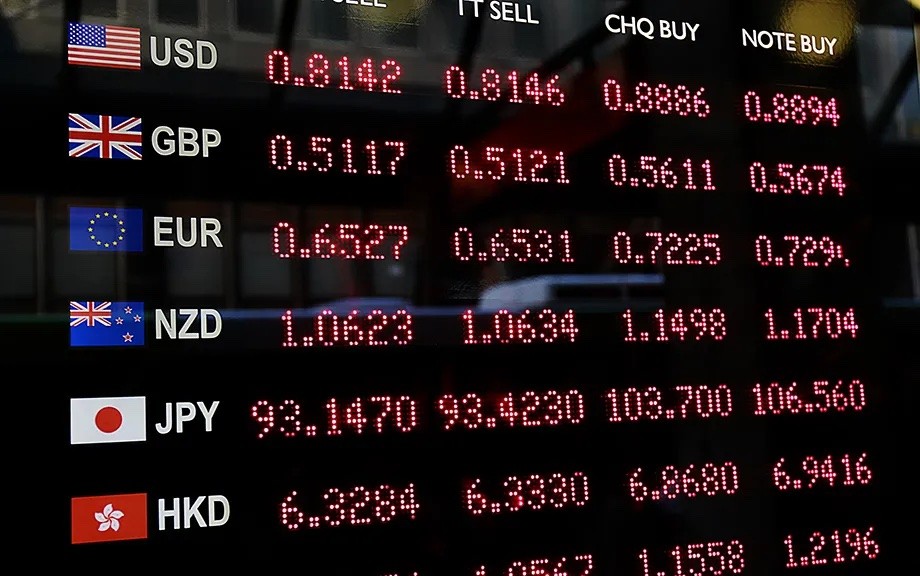
Businesses today are often blind to the true cost of currency conversion. Banks and even mainstream PSPs frequently add hidden markups to exchange rates — often in the range of 2–4%. These costs aren’t always itemized; they’re embedded quietly into the rate, draining margins without transparency.
Best practices for managing exchange rate exposure include:
Holding balances in native currency: Platforms like Wise and Revolut Business allow you to store funds in multiple currencies and convert when market conditions are favorable — rather than automatically at the time of payment.
Using hedging instruments: Larger businesses can explore forwards, options, or contracts for difference (CFDs) to lock in rates for future payments. These tools help mitigate losses during periods of extreme volatility.
Strategic PSP selection: Choose payment processors that offer real mid-market rates or transparent currency conversion fees. Wise and Airwallex, for example, consistently offer more competitive FX pricing than traditional acquirers.
Invoicing in stable currencies: B2B merchants working across unstable economies can price in USD, EUR, or GBP — mitigating exposure to weak or fluctuating local currencies.
Global Case Studies: From the Thai Baht to the Japanese Yen
Currency swings have shaped global commerce in dramatic ways — none more so than the Asian Financial Crisis of 1997, when Thailand’s currency devaluation set off a wave of capital flight across Southeast Asia. That event revealed how fragile emerging market currencies could become under speculative pressure and external debt.
More recently, the Japanese yen has seen bouts of sharp appreciation — particularly during global crises — due to its status as a “safe haven” currency. In 2022–2024, carry trade reversals caused the yen to swing wildly, affecting Japanese exporters and investors with dollar liabilities.
Even the Euro, once feared to collapse during the sovereign debt crisis, has demonstrated remarkable resilience — but not without generating pricing uncertainty for merchants selling into or from Europe.
These historical events are more than just academic—they inform how businesses and payments platforms should manage risk in today’s interconnected FX ecosystem.

Leveraging Digital Wallets
One often-overlooked solution for mitigating FX risk is multi-currency digital wallets. Fintechs like Payoneer, Wise, Airwallex, and Revolut Business offer wallets that let businesses store funds in the local currency of the market where they earn revenue. This delays conversion until rates become more favorable or capital is actually needed.
This approach not only prevents losses from immediate unfavorable conversions but also gives businesses control over timing. For example, a seller who earns €100,000 in the EU can keep it in euros — even if they’re based in Singapore — and convert to SGD only when the euro strengthens.
The Payments Angle: Fluctuations as Strategy, Not Threat
Rather than viewing currency volatility as a risk to be feared, it can be reimagined as a strategic variable. Smart businesses don’t just react to currency movements — they build payment flows that leverage them.
Use TreviPay or B2B net terms providers to control timing on receivables, gaining more predictability in cash flow and exchange exposure.
Diversify PSPs and bank accounts across jurisdictions to minimize overexposure to one currency or economy.
Audit your existing payment stack for hidden FX fees — even a 1% savings on millions in annual volume can mean six-figure improvements to net revenue.

Conclusion
Currency risk is a permanent feature of international business — but with the right payments infrastructure, it becomes manageable. Companies that take the time to understand their FX exposure and build systems to manage it are better positioned to protect profits, improve operational stability, and move with more agility in global markets.
At Compaytence, we help businesses design modern, cross-border payment systems with FX strategy at the core. With decades of experience across payments, fintech, and international banking, we support teams in building resilient frameworks for growth — even in volatile markets.