Retail technology has spent years accelerating.
Checkout flows shortened. Catalogs expanded. Marketing and fulfillment tools multiplied. Automation quietly embedded itself across the stack, reducing manual work and increasing reach. Each improvement pushed commerce forward, enabling businesses to operate at greater volume and velocity.
Over time, these changes enabled businesses to operate at greater volume and speed.
As systems grow more complex, the next inflection point centers on coordination, timing, and execution. Decisions increasingly need to move at the same speed as intent.
Microsoft’s latest announcement points toward that next phase.
With the release of a new suite of agentic AI solutions for retail, Microsoft is advancing commerce systems toward a model where intelligence actively participates in day-to-day operations. Discovery, checkout, merchandising, catalog management, and operations are being designed to work in concert, guided by context and continuous signals.
This is the foundation of agentic commerce, where software carries momentum forward without waiting for constant instruction.
Capturing Intent Where It Forms

One of the most visible developments in this shift is Copilot Checkout.
Copilot Checkout allows consumers in the United States to complete purchases directly inside Microsoft Copilot. Products discovered through conversational search can move through to transaction without leaving the environment where interest first appeared. Payments flow through established partners including Shopify, PayPal, and Stripe, with merchants maintaining ownership of the transaction.
The relevance of this approach sits squarely in how consumers now discover products.
Shopping journeys increasingly begin with questions. Customers compare options, seek reassurance, and refine preferences through conversational interfaces long before navigating to a product page. Adobe data shared by Microsoft shows that AI-driven eCommerce traffic surged 693 percent year over year during the 2025 holiday season, underscoring how quickly these behaviors are becoming mainstream.
Copilot Checkout aligns transaction capability with that moment of exploration. The path from curiosity to purchase becomes shorter, more direct, and less fragile.
Kathleen Mitford, Corporate Vice President of Global Industry at Microsoft, described the goal as helping retailers make faster decisions while strengthening customer relationships and building operational resilience.
This design preserves familiar payment rails while expanding where commerce can happen. Products surface in places where customers are already thinking, comparing, and deciding.
Storefronts That Guide, Not Just Display
Agentic commerce continues beyond the transaction itself.
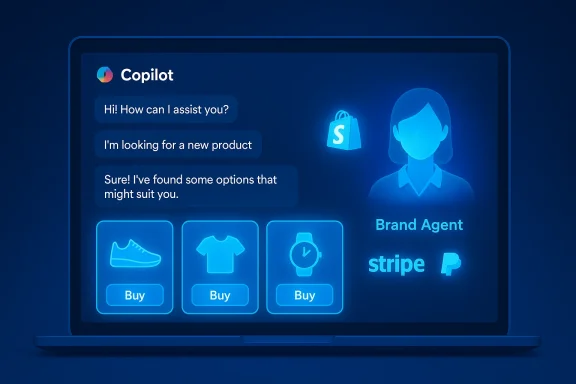
Microsoft’s Brand Agents and personalized shopping agent templates introduce conversational intelligence directly into digital storefronts. These systems are trained on product catalogs, brand language, and contextual signals, enabling them to respond to detailed questions, guide exploration, and support purchasing decisions in real time.
Shopping becomes more interactive and more responsive to individual needs. Instead of navigating static pages, customers engage with interfaces that understand purpose, constraints, and intent.
This shift carries meaningful implications for performance. When shoppers feel confident in their choices, conversion improves and post-purchase friction declines. Decision support becomes part of the experience rather than an afterthought.
Kappahl Group, which is exploring Microsoft’s personalized shopping agent framework, has pointed to stronger decision guidance as a way to improve conversion while reducing returns. Confidence emerges as a measurable outcome.
Etsy’s Chief Product and Technology Officer Rafe Colburn emphasized reach and timing, noting that bringing Etsy’s inventory into Copilot allows sellers to appear where high-intent discovery already takes place. The experience remains aligned with the brand while extending into new surfaces.

In this environment, storefronts evolve into adaptive interfaces that respond continuously to how customers engage.
Product Data That Keeps Pace
Underpinning these experiences is product data that moves quickly.
Catalog management has long been a quiet constraint in ecommerce. Missing attributes, inconsistent classifications, and outdated listings affect search relevance, recommendations, advertising performance, and fulfillment planning. These issues often persist because maintaining catalogs at scale demands constant manual effort.
Microsoft’s catalog enrichment agent template, now available in public preview through Copilot Studio, addresses this challenge by automating product data enhancement. The system extracts attributes from images, enriches listings with external signals, resolves inconsistencies, and keeps information structured across channels.
Guess, an early adopter, described the result as product details becoming more informative and actionable in real time, supporting discovery and personalized recommendations across touchpoints.
As product data stays current and structured, downstream systems gain sharper context. Search improves. Recommendations align more closely with shopper needs. Merchandising decisions draw from fresher signals.
Catalogs take on a more active role within the commerce ecosystem, continuously informing how products surface and perform.
Operations That Move With the Business
The same agentic principles are now shaping operations.
Microsoft’s store operations agent template equips teams with real-time insight through natural language interfaces. Inventory availability, store policies, staffing considerations, and performance indicators become immediately accessible and actionable.
These agents draw from internal data such as sales trends and foot traffic, alongside external inputs including weather patterns, holidays, and local events. They surface priorities, flag exceptions, and support coordinated responses across teams.
John Khoury, Group CTO at Strandbags, highlighted how this approach allows teams to respond to live conditions as they unfold, reducing lag between insight and action.
For commerce businesses operating across locations or channels, coordination often determines speed. Agentic systems help maintain alignment as conditions change.
Commerce Systems Learn to Act
Taken together, these developments signal a meaningful evolution in how commerce systems operate.
Retail platforms are being shaped into environments that respond continuously, guided by context and shared intelligence. Discovery, checkout, fulfillment, and operations increasingly inform one another, creating tighter feedback loops and faster execution.
Human involvement remains central. Strategy, oversight, creative direction, and governance continue to rely on people. What changes is the burden of execution. Software handles orchestration, monitoring, and routine optimization, allowing teams to focus on higher-level decisions.
Industry coverage over the past year has noted the movement from generative AI toward systems capable of carrying out complex workflows. Microsoft’s retail announcement brings those concepts into active deployment across the value chain.
For eCommerce operators, advantage begins to hinge on how well systems are trained, integrated, and governed. The technology itself is becoming more accessible. The differentiator lies in how effectively it is applied.
Agentic commerce unfolds as systems gain the ability to work together, adapt to context, and maintain momentum without constant intervention.