
The Checkout Your Buyers Want
Compaytence Brief · August 31, 2026

Most checkout optimization focuses on removing friction: fewer fields, faster pages, clearer offers. But for international businesses, building the checkout your buyers want starts with something more fundamental: understanding how they actually prefer to pay.
That changes dramatically once you cross borders. A payment experience built around cards may feel complete from a US perspective, but in many major eCommerce markets, cards aren’t the primary way people pay online. A customer can reach checkout ready to buy, encounter no technical problem at all, and still leave because the payment method they expected to see simply isn’t there.
Stripe put a number on the impact in 2025. In a holdback experiment across its Optimized Checkout Suite, merchants offering at least one relevant payment method beyond cards saw revenue increase 12% and conversion increase 7.4%. The market-level results were even more striking: adding BLIK in Poland increased conversion 46%, iDEAL in the Netherlands 39%, and Alipay in China 91%.
These aren’t survey results about what consumers say they prefer. They show what happened to actual checkout performance when the buyer’s normal way of paying appeared.
Cards Are Not the Default Everywhere
Payment behavior changes dramatically from one market to the next. Worldpay’s Global Payments Report 2026 shows that while cards remain dominant in some countries, they account for less than half of eCommerce transaction value in many others.

Share of eCommerce transaction value by payment method, 2025
The contrast is striking. Cards account for 55% of eCommerce transaction value in Mexico, but only 44% in Brazil, 25% in Malaysia and 7% in Indonesia. Even in the United States and United Kingdom, cards represent less than half of eCommerce transaction value in Worldpay’s data. As card share falls, the balance moves toward digital wallets, bank transfers and account-to-account payments, along with other local payment types.
But the category-level view only tells part of the story. In several important markets, a specific local payment method or payment behavior has become deeply embedded in how consumers buy online.
Market | Dominant method | Share | Source |
|---|---|---|---|
Netherlands | iDEAL | 71% of online transactions | Betaalvereniging Nederland, 2025 |
Poland | Account-to-account (mostly BLIK) | 70% of eCommerce value | Worldpay GPR 2025 |
India | UPI-based wallets | 68% of online value | Worldpay GPR 2026 |
Brazil | Pix | 42%, ahead of credit cards at 41% | PCMI / Worldpay, 2025 |
Germany | PayPal 28.7%, invoice-after-delivery 26.1% | Cards trail at 13.7% | EHI Retail Institute, 2025 |
Germany is particularly striking. Invoice-after-delivery alone accounts for more German online revenue than every card scheme combined. In the Netherlands, iDEAL accounts for 71% of online transactions, while Poland and India have similarly concentrated payment behavior around account-to-account payments and UPI-based wallets.
For an international merchant, the implication isn’t that cards no longer matter. It’s that “we accept cards” and “our customers can pay us the way they expect to” are increasingly two different things.
That difference can also be difficult to see in your data. A declined card creates a payment event that can be investigated. A shopper who reaches checkout, doesn’t see the payment method they normally use and leaves creates no equivalent signal. The dashboard simply records another abandoned checkout.
Adding the Right Method Isn’t Always a Switch
Once you identify a missing payment method, the obvious response is to add it. This is where payment strategy collides with infrastructure, because what your processor supports and what you can actually put in front of a customer are not always the same thing.
Your commerce platform is the first constraint. Shopify Payments supports a broad range of local methods, including iDEAL, Bancontact, BLIK, Przelewy24, Swish and MobilePay, and can display them based on the customer’s market. WooCommerce gives merchants considerably more freedom to combine gateways. ClickFunnels introduces currency and checkout-flow limitations that can affect which methods are practical, particularly for subscriptions. Kajabi supports multiple processors, but its documentation does not clearly establish support for redirect-based local methods.
Then comes the less obvious constraint: where your business is registered.
Stripe, for example, allows a US-incorporated account to accept iDEAL, Bancontact, Przelewy24, SEPA Direct Debit and Klarna. So accepting iDEAL does not necessarily require a Dutch entity. But BLIK, Swish and MobilePay are restricted to EEA-region business locations.
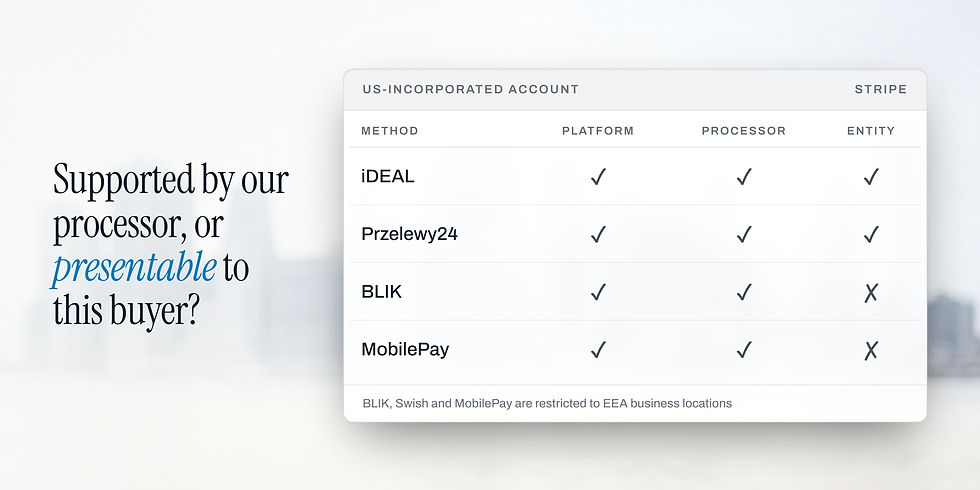
Pix shows how quickly the answer can change depending on the processor. Adyen requires a local Brazilian entity for Pix, while Stripe provides a cross-border route through EBANX for eligible US accounts. It is the same payment method and the same Brazilian buyer, but a very different answer depending on the processor and entity behind the checkout.
This is why asking “Does our processor support this payment method?” isn’t enough. The better question is: Can our entity, through our processor and our platform, actually present it to this customer?
When You Hit the Entity Wall
If your existing structure can’t access an important market or payment method, the answer isn’t automatically to incorporate locally. There are other ways to extend payment coverage, and two of the most common are Merchant of Record and local acquiring.
A Merchant of Record becomes the legal seller and takes responsibility for areas such as tax collection and remittance, compliance and payment-method access. Paddle and Lemon Squeezy both advertise pricing of 5% + $0.50 per transaction. The tradeoff is relatively straightforward: you pay more per transaction in exchange for outsourcing a significant part of the infrastructure and compliance burden.
Local acquiring solves a different problem. You remain the seller, while an acquirer with local licences processes the transaction closer to the customer’s market. This can expand geographic reach and improve authorization performance. Checkout.com reported acceptance-rate improvements of 4.6% for THG Ingenuity and 4.15% for Vinted in examples involving local acquiring, while FlixBus reduced US bank declines by 21% through local acquiring with Adyen.
The right structure depends on the market, your volume and how much control you want to retain. The important point is that forming another company in another country is only one tool in the box.
Start With Your Traffic, Not Your Revenue
If you want to find the payment gaps in your business, don’t start by ranking countries by revenue. Rank them by sessions.
Revenue tells you where customers successfully bought. It can hide markets where significant numbers of potential customers are arriving but never completing checkout. Traffic gives you a better starting point for finding markets where payment coverage may be suppressing conversion before a transaction is ever attempted.
Take your five largest traffic markets and compare the payment methods consumers actually use there against what your current platform, processor and entity can present. The gaps will usually fall into one of three categories: configuration, infrastructure or entity.

A configuration problem might take an afternoon to fix. An infrastructure problem may require another processor or local acquiring relationship. An entity problem can change the economics of entering the market entirely. The important thing is knowing which problem you actually have before you start rebuilding the stack.
Because the most expensive payment failure isn’t always a declined transaction. Sometimes it’s the transaction the customer never attempts.
How Compaytence Fits
A Compaytence payment audit maps your customer geography against what your existing platform, processors and entity structure can actually support. We identify which gaps can be solved through configuration, which require different payment infrastructure, and which genuinely justify a new entity.
Where US infrastructure is part of the solution, the Compaytence U.S. Expansion Suite coordinates formation, EIN, banking and processor onboarding as one build.
Sources
Stripe, “Testing the conversion impact of 50+ global payment methods,” April 2025
Worldpay / Global Payments, Global Payments Report 2026
Worldpay, Global Payments Report 2025
Betaalvereniging Nederland, 2025 payment statistics
EHI Retail Institute, Online-Payment 2026
PCMI / EBANX, Beyond Borders 2026
Stripe payment-method support documentation
Adyen payment-method and local acquiring documentation
Shopify, ClickFunnels, WooCommerce and Kajabi payment documentation
Checkout.com case studies
Paddle and Lemon Squeezy pricing and Merchant of Record documentation


Comments